When I was little, my mum used to take me to visit my great gran in her flat in Cardiff.
She had a ground-floor flat, very small, but always so clean and tidy. She would make us tea in a big teapot with a knitted tea cosy on top. I remember her little garden, and a peg dolly that used to hang on the washing line. Sometimes I would play with her very old manual hoover — the kind with a circular brush inside that turned as you pushed it, sweeping the dirt into a little collecting bin.
Her flat was full of fascinating little things that I, as a small child, was obsessed with. Little white lace doilies that she lovingly and carefully placed on her bedside table. A small mirror crowned with daffodils and poppies. A wash jug and basin. So many little objects that seemed to belong to another world, and which I loved without really understanding why.
And whenever I visited, she would give me a tube of Smarties, which I devoured, always looking for the orange ones first.
The corn dolly
My mum and great gran were very close. From what Mum tells me, Great Gran practically raised her.
When Mum was getting married, Great Gran took her shopping in Cardiff. There used to be a big department store in the city centre called David Morgan — I actually remember going there with my gran when I was small, too.
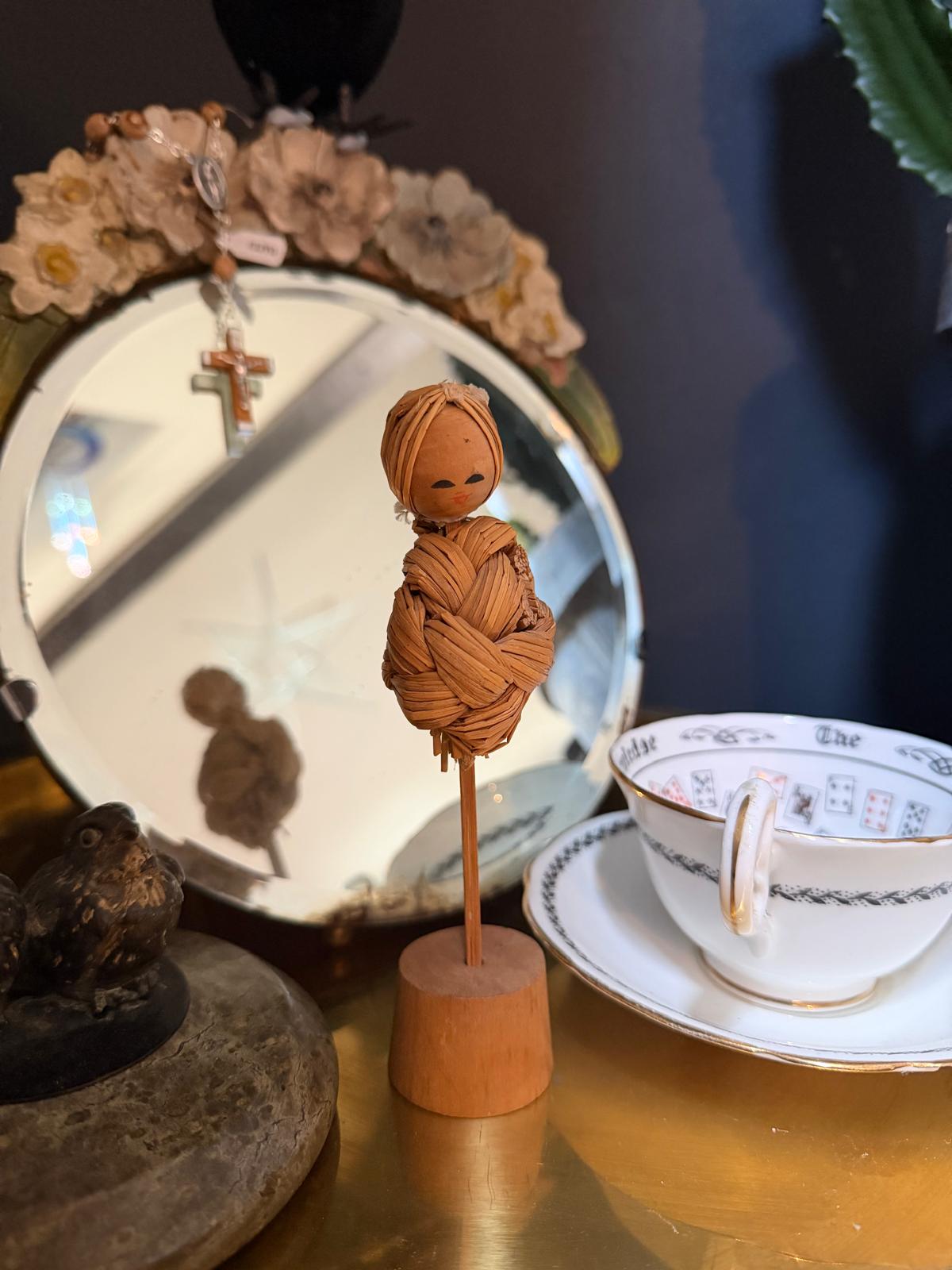
It was there that Mum saw a little corn dolly, and Great Gran bought it for her.
Great Gran didn't have a lot of money, and this was a little luxury. Mum treasured the dolly for many years afterwards, until eventually she passed her on to me.
By then, though, she was showing her age.
Over the years she had lost her skirt, the delicate and brittle wheat snapping away. Her lovely little hat had come off. What remained was still recognisably her, but she was in need of some care.
For a long time, I had absolutely no idea what to do with her.
My first thought was to sew her a new skirt. But because she is so tiny, the drape of the fabric never looked quite right, and attaching anything neatly around her little waist proved surprisingly difficult. I started over a few times, couldn't quite make it work and, as these things often do, the project fell by the wayside.
Then autumn came.
And with autumn comes the equinox, the harvest, and all the quirky little countryside traditions that go along with it.
Including, of course, corn dollies.
The last sheaf
Long before I knew anything about corn dollies, the last few stalks of a harvest had a significance of their own.
Across Britain there were different traditions surrounding the final sheaf, but in Wales one of the best recorded was Y Gaseg Fedi — the Harvest Mare.
At the end of the harvest, a small patch of corn would be deliberately left standing. In parts of west and mid-Wales it was tied or plaited, and the reapers took turns throwing their sickles at it from a distance until somebody finally brought it down.
The little bundle had different names in different places. In parts of Cardiganshire and Carmarthenshire it was Y Gaseg Fedi, while elsewhere the last sheaf might be known as Y Wrach — the Hag.
And it wasn't simply thrown away.
The final sheaf might be carried home and hung in the farmhouse or barn, or kept until the following year's planting. In one recorded Welsh tradition it was eventually returned to the fields and ploughed back into the earth with the new crop.
There were less solemn traditions, too.
On some farms, the Harvest Mare was secretly carried into a neighbouring field where the harvest was still unfinished — a fairly pointed joke at the expense of the slower reapers. The person delivering it then had to make a quick escape, because the neighbouring workers could apparently respond by throwing their sickles after them.
I particularly like that detail. Sometimes when we talk about old traditions we have a tendency to make our ancestors terribly solemn. Apparently, they were also quite happy to spend harvest time winding up the neighbours.
The spirit in the corn
There is another idea that became closely associated with these traditions.
Folklorists in the nineteenth and early twentieth centuries interpreted customs surrounding the final sheaf as remnants of an older belief: that something of the life or spirit of the crop remained amongst the standing corn.
As the field was cut, the spirit retreated further and further until eventually it was contained within the very last stalks. By weaving those stalks into a figure and bringing it home, the life of the harvest could, in some sense, be preserved until the following year.
It is a wonderful story, although probably not quite as straightforward as it is sometimes presented.
We can't really know whether the people cutting the Harvest Mare believed there was literally a little corn spirit hiding inside it. The traditions varied enormously from place to place, and later folklorists had a habit of trying to find one ancient explanation for customs that may have had many different meanings to the people actually practising them.
What survives much more clearly is the act itself.
The last of the harvest was singled out, made into something, and kept.
And perhaps that is the part that appeals to me most.
To take something temporary — a crop that has grown, ripened and been cut down — and turn a small part of it into an object that carries the harvest beyond its season.
There is a lovely Welsh example of this kind of keeping in the collection of Amgueddfa Cymru. In Gower, a model corn rick was made from wheat straw in around 1887 and used as the centrepiece of an annual harvest thanksgiving service at Llanilltud Gŵyr. Members of the same family carried it to and from the church each autumn for more than a century, until eventually the straw became too fragile for it to continue.
More than a hundred harvests, represented by one small object carefully carried forward.
My corn dolly
All of this made me look at my own little corn dolly rather differently.
I don't know who made her. I don't know whether the person who made her was thinking about Harvest Mares, corn spirits or any of this at all.
She may simply have been a pretty little piece of straw craft sitting on a shelf in David Morgan in Cardiff, spotted by a young woman shopping for her wedding with the grandmother who had helped raise her.
But more than forty years later, she has somehow become exactly what those old harvest objects were supposed to be.
Great Gran bought her for Mum. Mum kept her all those years. And then Mum gave her to me.
And now she is mine to look after.
Mending her
When I came across the tradition again this autumn, something clicked.
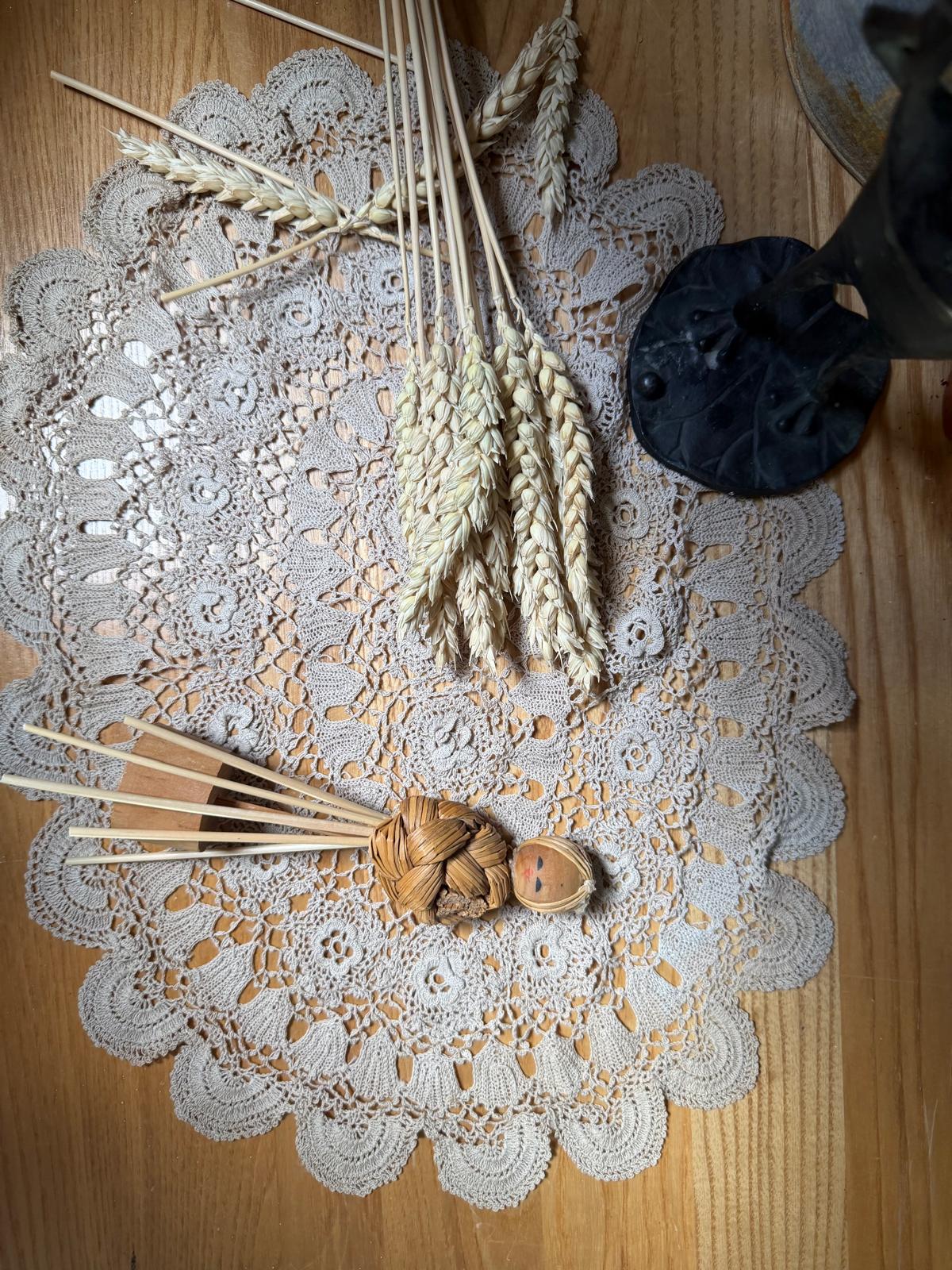
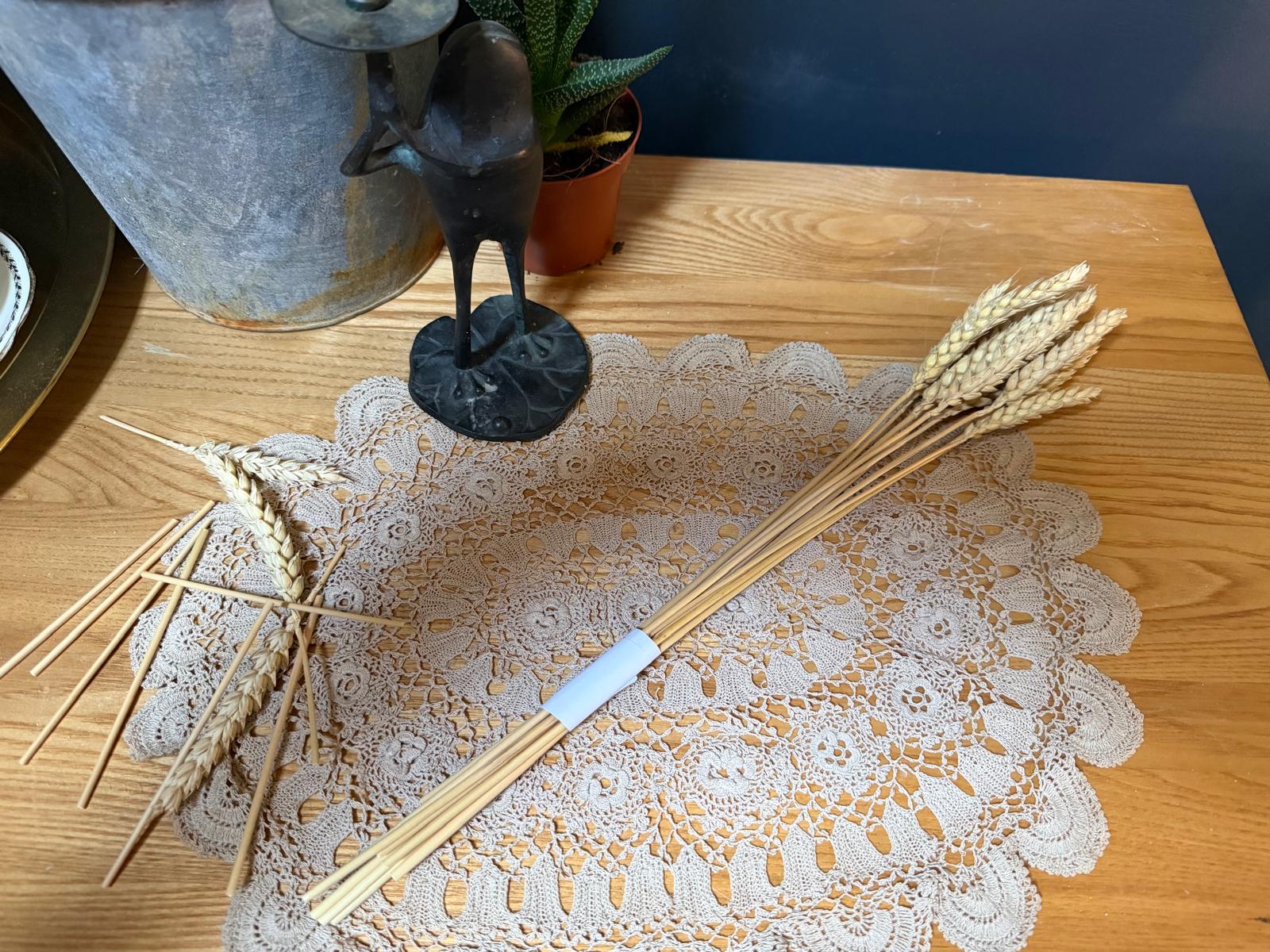
I started researching how corn dollies were actually made. I watched far too many YouTube videos on straw plaiting and knotting, looking for inspiration, and bought some barley freshly cut from the 2026 harvest so that I could have a go myself.
And somewhere in all that research, I found the answer to a problem I had been trying to solve for years.
In one of the videos, someone demonstrated how to join a fresh piece of straw onto another piece in order to continue the weave.
That was it.
I didn't need to invent a completely new skirt for her. I could repair what was already there.
I could cut the new straw to length and carefully fit it over the broken ends of the original, securing the joins and rebuilding her skirt from there.
And that is where you find me now, partway through yet another little project.
There is something incredibly satisfying about the materials themselves. Straw is so ordinary and so temporary. Left alone in a field it bends, breaks and eventually disappears back into the earth. Yet someone took a handful of it decades ago and made this tiny woman. My great gran saw her in a shop in Cardiff and spent money she didn't really have to spare to buy her for her granddaughter.
My mum kept her.
And now I am sitting in my house, all these years later, repairing her with barley cut from another harvest.
I started this because I wanted to fix a broken skirt.
Somehow, it has become another small way of reclaiming a little of my heritage and reconnecting with the people who came before me — the ones I remember, and the ones much further back whose names I will never know.
Perhaps that is why these little domestic objects matter so much to me.
They don't have to be valuable. They don't even have to survive perfectly.
They just have to be kept.
And so I am repairing an old harvest object with the harvest of another year.
Carrying a little piece of it forward.